
Poetry written by acclaimed writers (such as Langston Hughes and Paul Laurence Dunbar) and by ordinary men and women filled the pages of African American newspapers from the 1890s to 1930. Their topics ranged from first love to lynching, from spring to disfranchisement–i.e., from beauty to brutality. They sought to follow the style of classical poets, and they used southern dialect. Regardless of their topic or style, they presented a people who sought the vividness of words to express their deepest feelings.
Some poems were short and direct:
I’m tired of high stench-filled galleries,
I’m tired of being scoffed like a clown,
I’m tired of rocky jim-crow cabooses,
I’m tired of seeing white folks around.
To devil with this white civilization,
Let’s get us something of our own,
Let’s build us shows and cabooses,
And let these white folk alone.
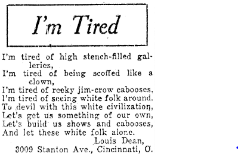
Pittsburgh Courier, August 3, 1929
A few were in dialect (as “Back to Georgia” by Welborn Victor Jenkins of Madison, Georgia) :
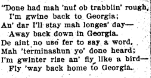
Atlanta Independent, November 13, 1909
And a few verses were written to the tune of popular (generally patriotic) songs, such as W. E. B. Du Bois’s “My Country, ‘Tis of Thee (in Alexander’s Magazine in February 1915):
My country, ’tis of thee,
Late land of slavery,
Of thee I sing;
Land where my father’s pride
Slept where my mother died,
From every mountain side
Let freedom ring!
Some were in the form of prayers: “And grant, O Lord, thy guidance/To those the lawless bands./Rid now their hearts of hatred./Cleanse, thou, their blood-stained hands./Deal them the depths of vision,/The reach of reason fair,/Beneath the cloak of color,/To see the manhood there.” ( From “The Prayer of the Sore Oppressed” by Edwin T. Jones in the Richmond Planet, August 11, 1900).
And others were in the form of motivatiional sermons:
Does your way seem dark and dreary,Troubles come to try your hear?
Do not let your soul grow weary:
If you know you’ve done your part,
Never mind.
Men, your burdens, may beguile;
On your efforts God will smile:
Labor on. . . .
Labor on and never mind. (From “Labor On and Never Mind” by Edgar G. Thomas, in the Richmond Planet, September 2, 1899)
Some of the poetry was written as conversations:
“Silence!” cries the speaker,
With profound logic he said,
“Beat the black man back, boys,
Or else he’ll get ahead.”
Just then a son of Ham said,
“Do whatever you might,
We are going to win, sir,
Because God is in the fight . . . .”
(“Dedicated to the Young Men of the Race. By Miss Up Lifter” by S.J.W. in the Atlanta Independent, October 29, 1910)
Other was filled with historical references or symbolism: “Bless the great Immortal Lincoln,/Whom He willed through martial strains,/Should be Saviour of our country/And should break old slavery’s chain./Think, oh think, of Brown, the martyr,/He who’s [sic] soul goes marching on!/Lovejoy, Garrison and Sumer!/Others, too, at Freedom’s dawn.” (From “Ever Loyal” by Eva Carter Buckner)
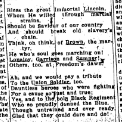
California Eagle, November 12, 1921 (and May 12, 1923)
Some poems focused on issues dominating current black conversation, such as that dedicated “To Charles Young, Leut. Colonel U.S. Army” (by William Nauns Ricks in the California Eagle, July 7, 1917:
Could I portray in words of grace,
The service you have done your race;
Could I but half such service do;
then I might pen a song to you.
And such as that by Eddie Thompson who connected the Great War with racial problems at home (from the Chicago Defender, October 5, 1918):
If I go over and fight
The Huns every inch without fail,
Will my brother I’ve left behind
Be lynched without trial?
Some verses were composed by white poets:
Out of the wilderness, out of the night
Has the black man crawled to the dawn of light;
Beaten by lashes and bound by chains,
A beast of burden with soul and brains,
And the cry of his heart is to know, to know!
(from “The Problem” by Ella Wheeler Wilcox [in the New York Journal] in the Washington Bee, September 20, 1902)
See sub-categories for the complete poems quoted above and for numerous other examples of the poetry that black (and white) Americans wrote about the status and future of African Americans.
