
Regardless of the Reconstruction Amendments–the Thirteenth, Fourteenth, and Fifteenth Amendments (1865-1870)–American leadership, law, and courts were hardly concerned with ensuring that black and white Americans enjoyed equal citizenship whether in schools, in the voting booth, in stores, and–with lives at stake–in the courtroom..
As early as 1906, the Richmond Planet of editor John Mitchell Jr. referred to a trial of a black defendant as a “legal lynching” even though it “lacked no essentials of justice.” As it explained, “We are not so much concerned as to the punishment of the accused [hanging] as we are about the use of the legal machinery as a weapon of the lyncher. Every fundamental principle of law was violated [in the fifty-five minute hearing] and the professed trial was no more than a farce. This is about as sure a way to undermine the law itself as it is to permit the lynching” (August 11, 1906).
Failure of states to treat alleged offenders and victims the same, as well as to enforce the amendments and related federal legislation, led to frequent newspaper editorials. Poems, editorial cartoons, and news stories also drew attention–and called on the nation to respond–to inequities that resulted in a decidedly second-class status for African Americans, most of whom continued to live in the South where the most grievous violations occurred.
The Great War’s crusade “to make the world safe for democracy” re-emphasized the humiliating, dangerous, and limited life of America’s black citizens. As the St. Louis Argus of January 21, 1916, clarified, “If a Negro is burned alive, he may get two paragraphs [in white newspapers], but no bitter denunciation in editorial comment. should such a horror be perpetrated on the battle-fronts of the bloodiest war of history, now raging in Europe, our great American press would go wild in denouncing the barbarity, but if a Negro is nailed in a pine box, saturated with coal oil and burned to a crisp in Mississippi, the news columns will tell the story simply, and the editorial page be as silent as death on this bit of Southern pastime.”
The Philadelphia Tribune on May 12, 1917, simply wrote, “Stop handing out hypocritical and lying statements of the great ‘Democracy of America.'”
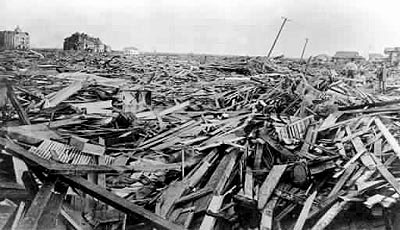
The result of the injustices was up the God, according to many editorialists, cartoonists, and poets. On August 19, 1911, the Washington Bee explained), “[I]t is an All Wise Master who enacts the eye and the tooth, and it’s the whites who pay the awful penalty. Retribution [by God] follows every crime,” as Galveston, Texas, learned when it was destroyed by the hurricane of 1900 “on the heels of the lynching of a Negro.”
http://www.ritainfo.com/1900-galveston-hurricane.html
