
From his first appearance on the national stage in Atlanta in 1895 to his death twenty years later, Booker T. Washington was central to African Americans’ perception of themselves, their status as Americans, and their fight for equality.
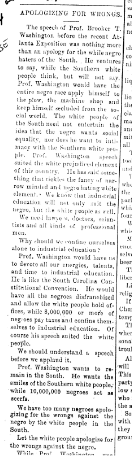
Washington Bee, October 19, 1895
The Washington Bee saw the former slave’s 1895 “Atlanta Compromise” speech as “nothing more than an apology for the whi[t]e negro haters of the South,” arguing that he wanted blacks to focus strictly on “the plow, the machine shop and keep . . . secluded from the social world.” His talk “tickle[d] the fancy of narrow minded and negro hating white element.” Rejecting Washington’s focus on industrial education and an economic base in the agricultural South, the Bee asserted that “we need lawyers, doctors, scientists and all kinds of professional men.” If African Americans followed Washington’s advice,”. . . all the negroes [would be] disfranchised . . . and confine[d] to industrial education,” paying taxes while whites held political power. As the Bee concluded, “He wants the smiles of Southern white people, while 10,000,000 negroes act as scerfs [sic].”
Support for the Alabama educator was, nevertheless, widespread. The Savannah tribune of March 8, 1902, published an article from the Atlanta Independent that bluntly stated that “. . . God has sent [him] to pull [the Negro] out of the slough as surely as he sent Moses to bring hispeople to the promised land.” However, opposition to Washington’s accommodationist approach and domineering personal/political style grew in the early 1900s. Frustration and anger grew, as demonstrated by the Cleveland Gazette‘s use of capital letters in a 1903 editorial. It quote Washington as saying, “[I]n all the world there is not the opportunity afforded us that there is in this country. WE HAVE NO REASON FOR COMPLAINT. IF WE DO NOT GET ON, THE FAULT IS WITH US, NOT WITH THE WHITE MAN!”
The Gazette continued,”How in the name of all that is good and holy booker Washington can say that our people “HAVE NO REASON FOR COMPLAINT” and intimate that they have not almost insurmountable barriers to climb in their effort to ‘get on,’ is more than we care to attempt to explain . . . . If mob violence and lynching, disfranchisement, the ‘Jim Crow’ car system and the thousand and one color-lines that our people bump up against daily throughout the country, in their effort to ‘get on,’ are not ‘good reasons for complaint,’ we would like to know what are. A vast majority of the opportunities to make a living and enjoy life, are closed tightly to the Afro-American. . . . Yet in the face of the fact, [Washington] has the supreme nerve and gall . . . to play to white galleries to say . . . that ‘WE HAVE NO REASON FOR COMPLAINT.’ . . . This is so palpably untrue that we cannot, for the life of us, understand how even Booker Washingtron can muster up nerve enough to say it.”
Still, the Atlanta Independent, noting that “. . . the race is badly in need of a Moses . . . ,” proclaimed that “all the substantial opposition that Booker t. Washington is encountering against his work of uplift has come from Negro traitors and muck-rakers.” These “. . . slanderers and traitors of his own race would have destroyed him to satisfy personal spleen.” (April 9, 1910)
Washington’s death in 1915 came after decades of battles with competing black leaders, most notably W.E. B. Du Bois, a founder of the NAACP and editor of its monthly Crisis.
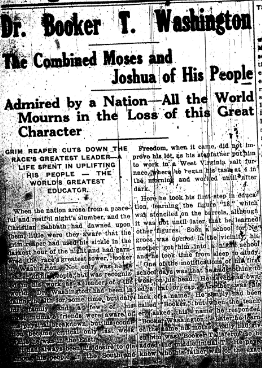
Kansas City Independent, November 19, 1915
While many African Americans, including newspaper editors, were much opposed to his publicly accommodationist policies, many others supported them as the only road to equality. His death was seen as a great loss.
Calling Washington “a leader of his people” and “a leader of the world,” the Kansas City Independent noted that his desire to die in his beloved South was fulfilled after an emergency return to Alabama so that he could take his last breath in his Tuskegee home.
