
In the late 1800s, some states devised the so-called “grandfather clause” in order to prevent black voting witout explicitly violating the Fifteenth Amendment which prohibited restrictions based on race. Only a man who was eligible to vote prior to a specified date–or whose ancestor (“grandfather”) was–could vote or avoid specific restrictions.
In an unusual victory for African Americans, the Supreme Court of the United States ruled unanimously (8-0) in 1915 that such limitations were unconstitutional. Their cut-off dates–such as Oklahoma’s 1866–were too closely linked to the end of slavery and the institution of black voting in the former Confederate states (1867) and in the nation (1870).
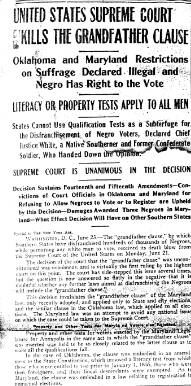
New York Age June 24, 1915
Oklahoma required a literacy test in order to qualify to vote, but it it also provided that “. . . no person who was, on January 1, 1866, or at any time prior thereto, entitled to vote under any form of government, or who at that time resided in some foreign nation, and no lineal descendant of such person, shall be denied the right to register and vote because of his inability to so read and write sections of such constitution.”
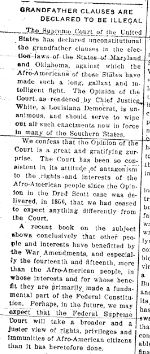
Philadelphia Tribune July 3, 1915
Chief Justice Edward Douglas White clarified the court’s view of the exception: “We have difficulty in finding words to more clearly demonstrate the conviction we entertain that this standard has the characteristics which the Government attributes to it [as unconstiutional] . . . . It is true it contains no express words of an exclusion from the standard which it establishes of any person on account of race, color, or previous condition of servitude prohibited by the Fifteenth Amendment, but the standard itself inherently brings that result into existence since it is based purely upon a period of time before the enactment of the Fifteenth Amendment and makes that period the controlling and dominant test of the right of suffrage.”
He continued, “In other words, we seek in vain for any ground which would sustain any other interpretation but that the provision, recurring to the conditions existing before the Fifteenth Amendment was adopted and the continuance of which the Fifteenth Amendment prohibited, proposed by in substance and effect lifting those conditions over to a period of time after the Amendment to make them the basis of the right to suffrage conferred in direct and positive disregard of the Fifteenth Amendment. . . . We say this because we are unable to discover how, unless the prohibitions of the Fifteenth Amendment were considered, the slightest reason was afforded for basing the classification upon a period of time prior to the Fifteenth Amendment.”
