
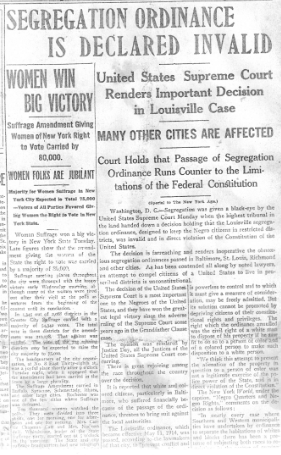
New York Age, November 8, 1917
In 1917, the Supreme Court of the United States struck down the residential segregation ordinances of Louisville, Kentucky. this seemingly rare victory for African Americans was actually a victory of property owners over states’ police power over public health, safety, and welfare. In Louisville, the city sought to maintain residential segregation by keeping some blocks white and some black by restricting to whom property owners could sell. In ruling that (white) property owners could not be limited in their right to sell property to (black) buyers, the court was not looking at the denial of equal rights based on race but on the familiar question of individual rights v. state power.
The response of some states with statutory requirements for the purposes of achieving residential segregation was to continue (in one form or another) their efforts to separate the races. In Harmon v. Tyler (1927), the court of Chief Justice William Howard Taft (the former president associated by African Americans with the Brownsville Affair during the Roosevelt Administration) held that a New Orleans residential segregation ordinance was a violation of the Fourteenth Amendment.
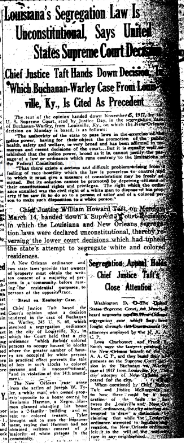
New York Age, March 19, 1927
The ordinance required that a majority of persons living in an area (i.e., whites) must agree to a property owner’s renting to a person of the opposite race (i.e., black). In this case, the property owner seeking to rent to blacks, Bejamin Harmon, was himself black. The white property owner across the street, Joseph Tyler, opposed his plan to divide his home and rent to blacks.
