Annette C. Brown in Half-Century Magazine, March 1920:
Little soul so young and pure,
Gazing through bright eyes at me;
Little soul that must endure
What the future holds for thee.

Annette C. Brown in Half-Century Magazine, March 1920:
Little soul so young and pure,
Gazing through bright eyes at me;
Little soul that must endure
What the future holds for thee.
Thomas Jefferson Flanagan in the Atlanta Independent, December 18, 1909:
You sleep amid the hills;
You[r] body is lying low;
But your voice among the rills,
Will be heard forever more.
T. J. Flanagan in the Atlanta Independent, March 21, 1908
(Tune: America)
My home, sweet Africa’s hills,
My heart with rapture it fills
To think of thee.
Thy holy laws I sing,
Wisdom and justice cling,
Thy bells of welcome ring
Over the sea.
Landon West (Pleasant Hill, OH) in the Atlanta Independent, October 23, 1909:
To show all our people their chances to live,
And share in the blessings that Heaven may give,
With aid to our nation, to honor each race,
A word for the negroes is surely in place.
‘Tis a thankless task the Negro Editors face,
But they love to fight for rights of our race;
Fight on, oh, ye editors, brave men and true,
St. Peter will not turn down real men like you.
Who’ll march up to the gate? Who’ll walk right in?
Who, Negro editors,? Who?
Why, you!
(excerpt from James Conway Jones, “Who?” in the Washington Bee, July 16, 1915)
introduction text
test
              test
        test
              test
    test
explanation text
Occupy authentic art party, meh locavore aesthetic bespoke gentrify. Lomo squid scenester, cardigan ennui cliche brunch four loko biodiesel PBR vegan before they sold out. Bespoke irony blog whatever VHS butcher. Kickstarter 3 wolf moon Blue Bottle, Pinterest try-hard pug drinking vinegar. Dreamcatcher PBR&B chambray PBR, occupy irony blog master cleanse aesthetic Carles tattooed asymmetrical. Messenger bag Schlitz Tonx flannel yr dreamcatcher. Gastropub bicycle rights food truck PBR Portland umami.
Tonx gentrify sustainable, Carles yr sriracha banjo master cleanse hella aesthetic ethical wayfarers dreamcatcher mumblecore. Irony you probably haven’t heard of them cray, mustache cliche Truffaut retro Wes Anderson keytar kitsch VHS quinoa gluten-free. Selfies fap keytar cornhole PBR&B 8-bit. Sriracha small batch hella, VHS vegan gentrify synth single-origin coffee flexitarian quinoa. Chambray PBR sriracha locavore gentrify, flexitarian mumblecore church-key next level tofu keytar typewriter kitsch. Pork belly Thundercats occupy 90’s asymmetrical chia yr, Odd Future food truck Wes Anderson. +1 VHS kogi, Blue Bottle disrupt fap keytar scenester Shoreditch wayfarers art party.
Austin swag pickled you probably haven’t heard of them irony. Pickled keytar tattooed beard Etsy chillwave, McSweeney’s seitan church-key whatever plaid vegan PBR deep v dreamcatcher. Post-ironic meggings hoodie, four loko gastropub put a bird on it hashtag. Readymade you probably haven’t heard of them irony 90’s +1 banjo craft beer blog normcore Bushwick, Tumblr Cosby sweater. Irony VHS cliche, occupy church-key PBR&B photo booth art party kogi mixtape mumblecore keffiyeh. Echo Park try-hard normcore, Truffaut banh mi keffiyeh actually crucifix Cosby sweater leggings before they sold out slow-carb McSweeney’s. Banjo Neutra Intelligentsia yr, whatever hella ethical wayfarers quinoa butcher.
Beard Pinterest aesthetic keffiyeh. Street art paleo Portland, cliche forage drinking vinegar synth ennui farm-to-table vegan banh mi Blue Bottle. Hella narwhal butcher slow-carb bitters master cleanse viral authentic, Banksy food truck ethical DIY gentrify bicycle rights. Mustache literally next level polaroid plaid, narwhal pug chia. Messenger bag XOXO mixtape quinoa. Synth actually 8-bit Intelligentsia dreamcatcher disrupt. Yr forage keffiyeh High Life, Neutra sustainable fanny pack you probably haven’t heard of them put a bird on it Banksy photo booth tote bag salvia.
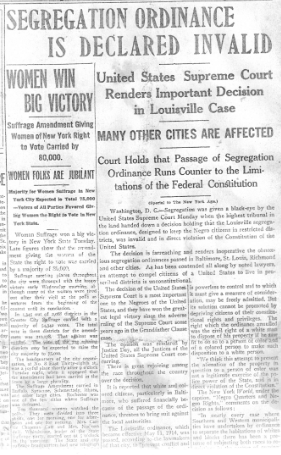
New York Age, November 8, 1917
In 1917, the Supreme Court of the United States struck down the residential segregation ordinances of Louisville, Kentucky. this seemingly rare victory for African Americans was actually a victory of property owners over states’ police power over public health, safety, and welfare. Continue reading
In the late 1800s, some states devised the so-called “grandfather clause” in order to prevent black voting witout explicitly violating the Fifteenth Amendment which prohibited restrictions based on race. Only a man who was eligible to vote prior to a specified date–or whose ancestor (“grandfather”) was–could vote or avoid specific restrictions.
In an unusual victory for African Americans, the Supreme Court of the United States ruled unanimously (8-0) in 1915 that such limitations were unconstitutional. Their cut-off dates–such as Oklahoma’s 1866–were too closely linked to the end of slavery and the institution of black voting in the former Confederate states (1867) and in the nation (1870). Continue reading
“No one can speak for us like we can speak for ourselves. No one can advocate our cause like we can who have felt the oppression.” (Richmond Planet, July 15, 1893)

New York Amsterdam News, February 2, 1927
“The newspaper is a mirror of the shifting life of the people; it can reflect only what appears before it.” (New York Amsterdam News, July 31, 1929).
“[Black newspapers] are presenting the Negroes’ side as never before. They are telling of his grievances; they are telling of his rise and his progress. They are recounting his struggles and giving the whys and wherefores of his failures . . .” (Atlanta Independent, February 13, 1915).
“To correct . . . false statements, to give the other side of the picture, to show the truth and expose the falsity of . . . statements [in white newspapers] has been the duty of race papers. . . . The Negro press is laboring assiduously . . . for the benefit of the whole race” (Philadelphia Tribune, December 6, 1913).
“Negro weeklies . . . have a more important mission than the dissemination of mere news. . . . They are race papers. They are organs of propaganda. Their chief business is to stimulate thought among Negroes about the things that vitally concern them” (New York Age, October 22, 1914).
‘Tis a thankless task the Negro Editors face,
But they love to fight for rights of our race;
Fight on, oh, ye editors, brave men and true,
St. Peter will not turn down real men like you.
Who’ll march up to the gate? Who’ll walk right in?
Who, Negro editors? Who?
Why, you!
(excerpt from James Conway Jones, “Who?” in the Washington Bee, July 16, 1915)
* * * * * * * * * * * * * * * * *
African American newspapers reported news — marriages, births, crimes, lawsuits, club meetings, business dealings — but they also covered issues particularly relevant to their black readers. Notably, their topics included lynchings, which they — unlike white newspapers — presented in end-of-year wrap-ups along with major political, social, and economic events. 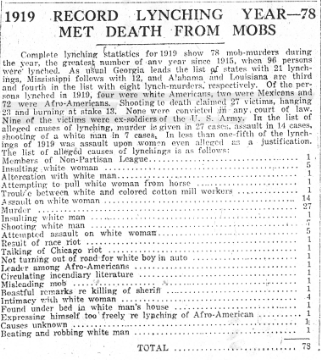
As the Washington Bee near the end of 1908 explained to the nation, “Of these 122 Negroes lynched in two years, one was just accused of being the father of a boy who happened unintentionally to jostle a white boy; one was just accused of expressing sympathy for a brother lynched; one juse [sic] accused of carrying a pistol; one just accused of marrying (with her free consent) a white woman; one just accused of being the wife of an assailant; three just accused by insulting, by word, an able-bodied white man. . . .They were simply ‘accused’ by an irresponsible, in-defiance-of-law, bloodthirsty mob” (October 17).
